

Vintage Pyrex can look surprisingly ordinary when spotted in a kitchen cabinet, thrift shop, or estate sale, but certain pieces tell a very different story. Collectors pay close attention to patterns, colors, condition, and production history, and a few unusual finds can command remarkable prices. Knowing what separates everyday Pyrex from the standouts makes the hunt much more interesting.
Why Vintage Pyrex Attracts Serious Collectors
Pyrex became a household name throughout the mid-twentieth century, producing colorful and durable bakeware that appealed to everyday cooks across the United States. What many people did not anticipate was that decades later, specific patterns and sets would transform into highly collectible items commanding impressive resale prices. The combination of nostalgia, scarcity, and aesthetic appeal has created a passionate collecting community willing to pay top dollar for the right piece.
Among the many factors that drive collector interest, completeness ranks near the top. Full four-piece sets are particularly desirable because individual bowls frequently broke, went missing, or became separated over years of household use (source). Finding a complete set in excellent condition is a genuinely rare occurrence, which is why intact groupings attract such attention at auctions and online marketplaces.
The Role of Limited Production in Driving Up Value
Not all Pyrex patterns were created equal. Out of more than 150 distinct Pyrex designs produced over the brand’s history, roughly 50 to 60 were promotional or limited-run pieces made in small quantities for specific purposes such as employee events, stamp redemption programs, or as experimental test items (source). These restricted production runs are precisely what separates a modestly priced thrift store find from a piece worth several thousand dollars.
Patterns tied to corporate promotional programs or employee-only distribution channels never entered the general retail market, meaning total quantities produced were extremely small. When collectors encounter these pieces today, the rarity factor pushes values dramatically higher than those of widely distributed patterns.
Standout Patterns That Command Premium Prices
A few specific designs have risen to near-legendary status among Pyrex enthusiasts. The Turquoise Golden Birds pattern from the 1960s is believed to have been produced exclusively for Corning Glass Works employees and was never made available to the public, with current estimated values reaching between $6,000 and $7,000 (source). The extremely limited distribution of this pattern makes authenticated examples extraordinarily difficult to locate.
Another pattern that collectors refer to as the “Holy Grail” of vintage Pyrex is Lucky in Love, a one-quart casserole featuring heart and four-leaf clover imagery that was manufactured in a very limited run during 1959 (source). Verified sales on platforms like eBay have seen this piece fetch upward of $4,000, and estimated collector values place it above $5,000 (source).
The Clover Berry pattern, also from the 1960s, features gold clover leaves set against a turquoise background. Its limited production run is thought to be connected to the early emergence of microwave cooking, which may have disrupted manufacturing timelines, with current valuations reaching between $5,000 and $6,000 (source).
Popular Patterns With Strong but More Accessible Values
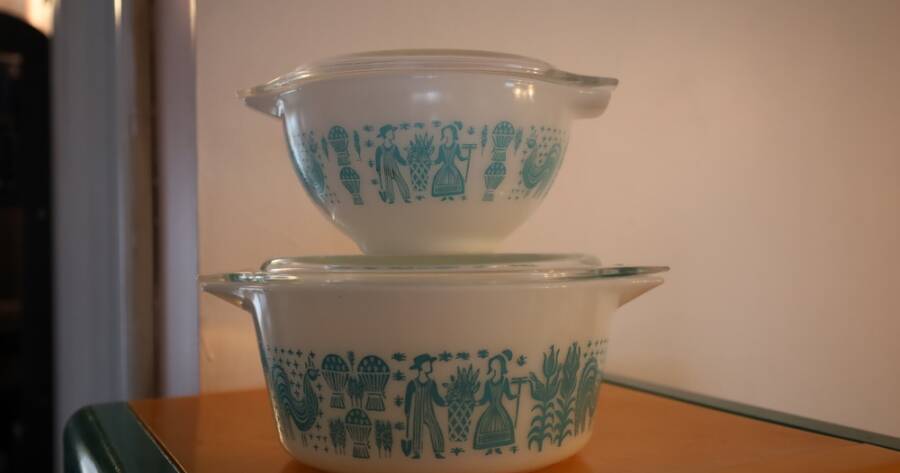
Not every valuable vintage Pyrex piece carries a five-figure price tag. Several widely recognized patterns attract strong collector interest while remaining somewhat more attainable. The Butterprint design, sometimes called the Amish or Farmer and Wife pattern, first appeared in 1957. A rare orange Butterprint Cinderella mixing bowl set in good condition carries an asking price around $600, while the Pumpkin Butterprint Cinderella four-piece set, produced exclusively for a stamp redemption program between 1965 and 1966, has an estimated value ranging from $800 to $1,600 (source).
The Cinderella bowl style itself deserves special mention. Introduced in 1957, these bowls were designed with molded handles and pouring spouts, features that gave patterned designs like Butterprint and Gooseberry an especially striking look when the bowls were nested together due to their alternating color arrangements (source).
The New Dots mixing bowl set, produced between 1969 and 1973, ranks among the most recognized Pyrex patterns ever made. Individual bowls from this set turn up fairly regularly at secondhand shops, but assembling a complete set is far more challenging and significantly increases the total value (source). Within earlier Dot sets from 1968 to 1973, the green dot bowl is considered especially hard to find due to a shorter production window (source).
The Atomic Eyes chip and dip set represents another collectible from the 1950s that crosses over into mid-century interest. Originally produced from 1950 through 1959, a complete set in excellent condition can exceed $600 on the resale market today (source).
What Determines the Value of a Vintage Pyrex Piece
Several interconnected factors shape how much any given vintage Pyrex item is worth. Condition is paramount, as chips, crazing, fading, or missing lids can significantly reduce collector interest and sale price. Pattern rarity is another major driver, with promotional and employee-exclusive designs consistently outperforming mass-market patterns. Set completeness matters enormously, since the difficulty of keeping every piece intact over decades of actual kitchen use means full sets are disproportionately scarce relative to individual bowls.
Provenance and authentication also play a role for the most valuable pieces. With top-tier patterns like Turquoise Golden Birds or Lucky in Love, buyers and sellers alike benefit from documentation or established sale history that supports authenticity. The broader vintage kitchenware market has grown sophisticated enough that collectors research sale records on platforms like eBay before setting expectations for pricing.
Why You Should Learn More About Vintage Pyrex Values
Understanding the factors that make certain vintage mixing bowls genuinely valuable is worthwhile for anyone who frequents estate sales, thrift stores, or has inherited mid-century kitchenware. The difference between a common Pyrex bowl and a rare promotional pattern can be enormous, sometimes amounting to thousands of dollars. Specific visual details, production dates, and the completeness of a set all contribute to a piece’s place in the collector market.
Knowing which patterns were tied to limited distribution programs, which color variants were made in shorter runs, and what condition standards serious buyers expect can transform how someone evaluates a potential find. Vintage Pyrex collecting rewards careful attention and ongoing curiosity about mid-century American kitchen history.