

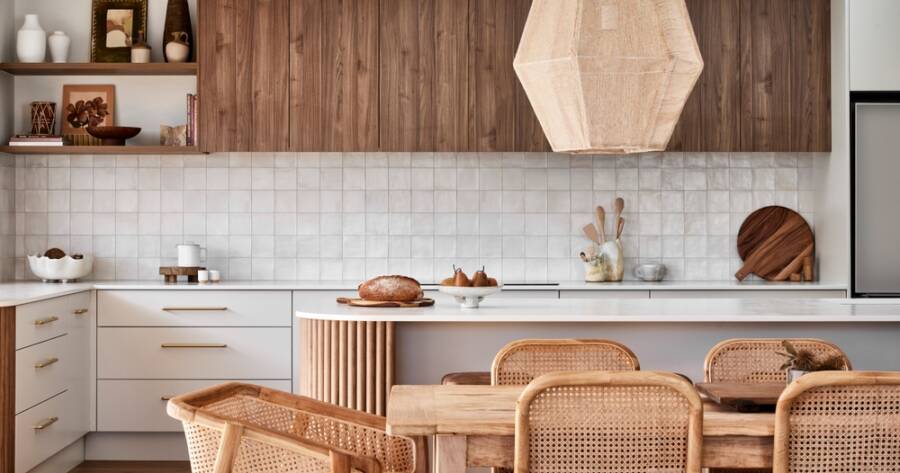
Kitchen design is evolving fast, and backsplashes are at the center of that transformation. Homeowners and designers alike are moving away from predictable materials toward surfaces that feel intentional, tactile, and deeply personal — reshaping how kitchens look and feel.
Why Traditional Backsplashes Are Falling Out of Favor
For years, white subway tile dominated American kitchens. It was safe, affordable, and universally accepted. But a growing number of designers and homeowners are pushing back against the notion that “safe” should be the standard for kitchen design. The backsplash — one of the most visible surfaces in the room — is increasingly being treated as an opportunity for genuine artistic expression rather than a functional afterthought.
Roy Marcus of Artistic Tile captures this shift well: “White subway tile will always be a ‘correct’ material, but backsplash design can and should be so much more rewarding,” advocating for natural and truly artisanal materials (source). That sentiment is resonating across the design world as clients begin requesting surfaces that tell a story rather than blend into the background.
Home renovation professionals are also responding to what they describe as a growing homeowner demand for more personalized, high-impact design choices in kitchens (source). The result is a market that’s shifting toward materials with history, handcraft, and visual depth.
Zellige Tile: Handmade Texture Takes Center Stage
Among the most talked-about alternatives to conventional tile, zellige has emerged as a standout. This handmade tile, rooted in North African craft traditions, features subtle irregularities in shape, glaze, and tone that give kitchen walls a richness no machine-made product can replicate. Each piece reflects light slightly differently, creating a dynamic surface that changes throughout the day as natural and artificial lighting shifts.
Renovation experts have highlighted zellige as a top choice for homeowners seeking added texture and an authentic artisan aesthetic in their kitchen (source). Designers are betting strongly on this artisan-and-maker movement throughout 2026, with particular enthusiasm for materials crafted by hand — from zellige to terra-cotta-glazed tiles (source).
The appeal of zellige goes beyond aesthetics. It signals a broader cultural shift toward valuing craft, slowness, and authenticity in spaces that were once defined by efficiency and uniformity. For homeowners investing in a kitchen renovation, zellige offers something that feels genuinely irreplaceable.
Seamless Slab Backsplashes: A Bold, Minimal Statement
On the opposite end of the texture spectrum, seamless slab backsplashes are drawing serious attention for their clean, uninterrupted visual effect. Rather than using individual tiles, this approach extends the countertop material — often stone, quartz, or large-format porcelain — directly up the wall in a single continuous surface.
This technique is one of the top emerging trends displacing conventional tile installations (source). The result is a kitchen that feels cohesive and uncluttered, with grout lines eliminated entirely. For those who favor a more modern or minimalist aesthetic, slab backsplashes deliver a sense of luxury and visual calm that a grid of individual tiles simply cannot match.
Natural stone slabs in particular are gaining ground here — marble with dramatic veining, quartzite in warm tones, and even bookmatched panels that turn the backsplash into something closer to a work of art. The material itself becomes the design statement.
Opalite and Glass Finishes: Iridescent Surfaces on the Rise
Another direction gaining significant momentum involves glass-based and opalite-inspired surfaces. These finishes carry a luminous, mother-of-pearl quality that shifts in color and tone depending on the light source and viewing angle. Rather than competing with cabinetry and countertops, they add depth and shimmer that elevates the entire kitchen palette.
Designer Darlene Molnar has specifically identified opalite-inspired finishes as a rising trend, noting that glass finishes with a mother-of-pearl look will be hard to miss in the year ahead (source). These surfaces work particularly well in kitchens that already incorporate metallic hardware or light-reflective countertops, creating a layered, jewel-like effect across the whole room.
For homeowners who want something distinctive but not overwhelming, this category offers a compelling middle ground — surfaces that are visually interesting without dominating the space.
Hand-Painted Tile and Bespoke Patterns
Beyond specific materials, a broader movement toward one-of-a-kind backsplash design is gaining traction. Designer Carly Moeller predicts that 2026 will bring more colorful tile and bespoke backsplashes, with professionals gravitating toward “hand-painted, unique patterns, and one of a kind materials” (source). This reflects a desire to treat the kitchen as a curated space rather than a purely functional one.
Hand-painted tiles allow homeowners to introduce motifs, color palettes, and compositional elements that align directly with their personal style. Whether that means Mediterranean-inspired floral patterns, abstract geometric arrangements, or something entirely custom, the backsplash becomes a focal point with narrative value. No two kitchens end up looking the same — which is precisely the point.
This trend also intersects with growing interest in supporting independent artisans and small-batch tile makers. Purchasing directly from craftspeople adds another layer of meaning to the finished product, connecting the kitchen space to a specific moment in time and a particular maker’s skill.
What This Means for Kitchen Renovation Planning
Homeowners considering a kitchen update should approach the backsplash decision with the same seriousness applied to cabinetry or countertop selection. The range of available directions — from seamless slabs to zellige to hand-painted ceramic — means that personal taste and the overall design vision of the space should drive the choice far more than default convention.
Working with a renovation professional who understands current material trends can help homeowners navigate the options and avoid selections that may feel dated quickly. The most successful kitchens being designed today tend to prioritize materials with depth, craft, and longevity over those chosen purely for their familiarity or affordability. That philosophy, more than any single material, is what’s defining the next chapter of kitchen backsplash design.
Learn More About Kitchen Backsplashes
The transformation happening in kitchen backsplash design represents something larger than a passing trend. Homeowners across the United States are reconsidering what their kitchens say about them, and the backsplash has become one of the most powerful ways to express that vision. From the irregular beauty of handmade zellige to the sweeping elegance of a stone slab, the options available today far exceed anything the subway tile era offered.
Materials with texture, iridescence, and artistic origins are now defining what modern American kitchens aspire to look like. Whether someone is planning a full renovation or simply replacing an outdated surface, understanding the direction that kitchen design is heading ensures that the decisions made today will still feel relevant and rewarding for years to come.