

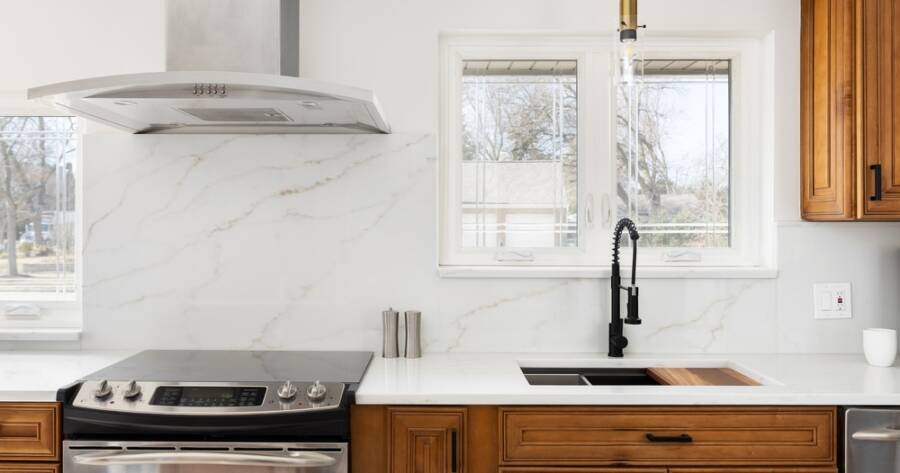
Kitchen backsplashes are moving well beyond the familiar row of tile. Homeowners and designers are using stone slabs, washable paint, plaster, mirrored glass, and other unexpected materials to create walls that feel more connected to the rest of the room. The right alternative can add texture, simplify the overall look, or turn an overlooked surface into a standout design feature.
Why Homeowners Are Moving Beyond Traditional Tile
For decades, ceramic and subway tile held an almost uncontested position in kitchen design. Today, however, professional designers and homeowners alike are pushing back against that convention. The desire for more personalized, cohesive kitchens has opened the door to a wide range of materials and approaches that prioritize both aesthetics and practicality. Rather than defaulting to what has always been done, today’s kitchen renovations reflect a more intentional, design-forward mindset.
The shift is not simply about appearances. Many alternatives to tile offer practical advantages, including easier maintenance, stronger visual continuity, and the ability to make smaller kitchens feel more spacious. As kitchen design becomes increasingly integrated with open-plan living spaces, the backsplash area is being treated as a meaningful design element rather than a purely functional afterthought.
Full-Height Stone Slabs: A Statement in Quiet Luxury
Among the most talked-about directions in kitchen design right now is the full-height stone slab backsplash. Rather than stopping at a standard height, these installations run continuously from the countertop all the way to the ceiling, producing an effect that feels both refined and dramatic. Natural stone such as marble and quartzite brings warmth and movement to the kitchen, and slab backsplashes featuring dramatic veining are expected to rise in 2026 (source).
The appeal goes beyond visual drama. When a single slab material flows without interruption from the work surface upward, it removes the visual clutter of grout lines and tile edges, creating what designers describe as “understated sophistication” (source). Full-height installations also support richer, moodier color palettes that might feel overwhelming at a smaller scale but read beautifully when given the full wall as a canvas (source).
Mixed Materials and the Art of Contrast
Another direction gaining traction involves combining two or more distinct materials in a single backsplash area. Pairing marble with patterned ceramic tiles, or setting industrial granite alongside glossy zellige, produces contrast and a finish that moves beyond conventional tile choices (source). The result is a surface that feels curated rather than catalog-standard.
This approach suits homeowners who want a kitchen that reflects individual taste. By introducing handcrafted tiles alongside natural stone, or blending matte and high-gloss surfaces, designers can create layers of texture and visual interest that no single material could achieve on its own. The mixed-material backsplash has become a way of injecting personality into what was once one of the most formulaic parts of a kitchen renovation.
Raw and Artisan Surfaces That Age Gracefully
Not every alternative to tile reaches for glamour. Some of the most compelling backsplash choices lean into texture and authenticity instead. Microcement, lime plaster, and timber paneling can give a kitchen wall more texture and character than a conventional tiled surface. Depending on the material and finish, some of these surfaces may also change subtly with age, adding to their natural, lived-in appearance (source). These surfaces tend to suit kitchen styles that emphasize warmth and natural elements over high polish.
Microcement in particular has attracted attention for its seamless appearance and durability. Applied directly to the wall, it eliminates grout lines entirely and creates a continuous surface that is easier to clean than traditional tile. Lime plaster offers a similar smoothness but with a softer, more organic finish that suits both modern and traditionally inspired kitchens.
Practical Alternatives: Paint, Upstands, and Mirrored Glass
For homeowners working with tighter budgets or rental properties where permanent changes are not an option, painted walls have become a surprisingly sophisticated choice. Brands such as Sherwin-Williams, Benjamin Moore, and Farrow & Ball offer durable, washable paint finishes that can work well on kitchen walls where a traditional tiled backsplash is not necessary (source). The right paint color can tie together cabinetry, countertops, and flooring in a way that a patterned tile sometimes cannot.
Upstands represent another practical option. An upstand uses a short section of material along the back edge of the counter to protect the lower part of the wall. Choosing the same finish as the countertop can make the transition between the two surfaces feel clean and coordinated (source). The effect is minimal and deliberate, lending itself well to contemporary kitchens where clean lines are a priority.
Mirrored glass takes a different approach entirely, using reflection rather than material texture to make a design statement. In kitchens that open onto a living area or face a garden, mirrored backsplashes can double a view and make the room feel significantly larger (source). While this choice is not for every style, it has found a loyal following in contemporary and mid-century-influenced kitchens.
What Homeowners Are Prioritizing Now
Across all of these trends, a common thread emerges: homeowners want their kitchens to feel intentional. Whether the choice is a sweeping marble slab, a rough-hewn lime plaster wall, or a simple painted surface, the unifying principle is that every element should contribute to a cohesive, considered whole. Tile still has its place, but it is no longer the default answer to every backsplash question.
Designers also note that many clients are drawn to materials that blur traditional boundaries. When a countertop material flows upward and becomes the wall, or when a single stone slab connects the cooking zone to the ceiling, the kitchen stops feeling like a collection of separate components and starts reading as an integrated space. That sense of visual continuity is driving some of the most exciting backsplash decisions being made right now.
Why You Should Learn More About Kitchen Backsplash Trends Today
The backsplash has become one of the most expressive surfaces in the modern kitchen. From full-height natural stone to artisan plaster and reflective glass, the options available today give homeowners far more creative latitude than standard tile ever did.
Whether a renovation is large or small, choosing the right backsplash material can elevate the entire room, improve ease of maintenance, and reflect a homeowner’s personal aesthetic in a lasting way. Understanding the full range of current alternatives helps any homeowner make a more informed, confident decision before a single material is purchased or installed.