

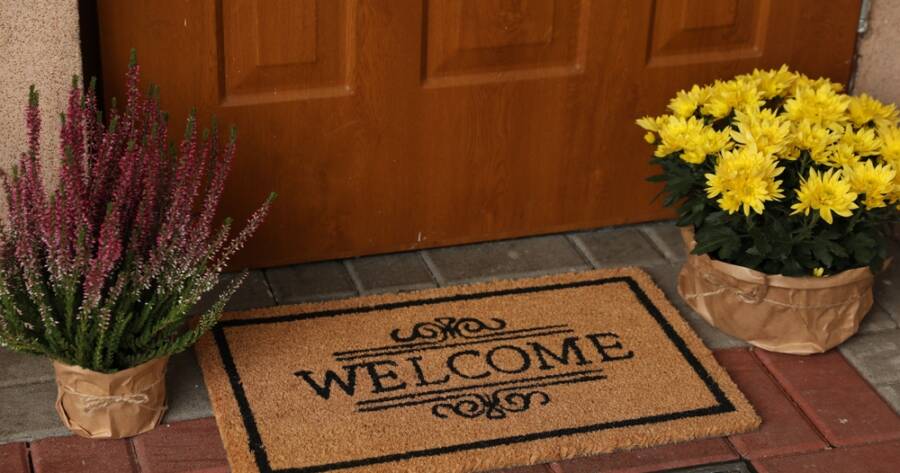
A wreath is no longer the default way to give a front entrance personality. Modern entryways increasingly rely on richer paint colors, coordinated hardware, sculptural planters, distinctive house numbers, and carefully chosen lighting. Key elements can make the door itself part of the architecture, creating curb appeal that lasts beyond a single season.
Let the Door Color Become the Decoration
One of the simplest ways to move beyond a wreath is to make the door itself the focal point. Current color trends are shifting away from predictable black, cool gray, white, and navy toward warmer, more expressive shades. Deep greens, earthy tones, soft pinks, and warm oranges can add character while still working with traditional or contemporary architecture (source).
The key is to choose a color that relates to the surrounding materials rather than treating the door as an isolated accent. Brick, siding, stone, trim, shutters, and roofing all affect how a shade appears. For homeowners who prefer a quieter entrance, a muted natural green can provide depth without becoming overpowering. Those who want stronger contrast can use the door as a concentrated burst of color while keeping the rest of the façade restrained.
Use Hardware and House Numbers as Design Features
Small permanent details can have as much visual impact as hanging décor. A substantial door knocker, streamlined handle set, modern mail slot, or coordinated lockset can make an older entrance look more considered. Current design advice favors consistency rather than mixing unrelated finishes; matte black, brushed nickel, and other understated metals can create a cleaner look than an assortment of competing hardware (source).
House numbers offer another opportunity for decoration without adding clutter. Designers increasingly treat their font, size, material, and placement as part of the exterior design rather than a purely practical necessity. Numbers can complement the architecture without matching it literally, while custom lettering can become a recognizable feature in its own right (source). Oversized vertical numbers, individual metal characters, or a minimalist address plaque can all provide a more permanent alternative to seasonal ornaments.
Frame the Entrance With Sculptural Greenery
Plants do not need to hang directly on the door to transform an entrance. Large planters placed beside it can provide height, texture, and symmetry while leaving the door itself visually uncluttered. Current designers also recommend real greenery over plastic floral decorations, which can fade and appear less convincing over time (source).
A pair of clipped evergreens can create a formal effect, while ornamental grasses, ferns, or flowering plants feel more relaxed. The containers matter as much as the plants: simple ceramic, concrete, metal, or fiberglass vessels can reinforce the home’s architectural style. Where space is limited, one carefully scaled planter can be more effective than several small pots competing for attention.
Replace Signs and Seasonal Clutter With Restraint
Modern front-door decorating often works best when fewer items are used. Generic welcome signs, multiple plaques, novelty statues, heavily themed mats, and several seasonal accessories can compete with one another rather than strengthening the entrance. Designers currently recommend a more edited approach in which a few intentional elements carry the visual weight (source).
That does not mean an entrance must feel bare. Instead of a large sign, homeowners might use an architectural door knocker or distinctive address numbers. Instead of several decorations around the threshold, one substantial planter and a simple natural-fiber mat can establish texture. Seasonal changes can then come from replacing plants or making subtle adjustments rather than redecorating the entire doorway.
Make Lighting Part of the Composition
Lighting is another way to decorate an entrance without attaching anything to the door. Well-proportioned sconces can frame it during the day and create a stronger architectural presence after sunset. Path lights or discreet uplighting can extend the effect outward, visually connecting the doorway with the walkway and landscaping (source).
The fixture should relate to the scale of the entrance and the other metal finishes nearby. A clean-lined lantern can suit transitional architecture, while compact geometric sconces can reinforce a more contemporary façade. Warm, controlled illumination generally creates a more inviting effect than extremely bright lighting.
Creating a Modern Entrance Without a Wreath
Moving beyond the wreath does not require filling the door with a different decoration. The strongest modern entrances often rely on the door itself, supported by paint, hardware, address numbers, greenery, lighting, and a restrained collection of accessories. Choosing a few coordinated elements creates an entryway that feels intentional throughout the year while still leaving room for small seasonal changes when desired.