

Loose gravel has plenty of appeal, especially for homeowners who like its natural look and relatively simple installation. Living with it can be another story. Shifting stone, uneven areas, frequent touch-ups, and difficult winter maintenance may eventually have homeowners searching for a different approach. Several alternatives can provide greater stability while still meeting different needs for drainage, appearance, durability, and budget.
Stabilized Gravel Keeps the Look With Less Movement
Homeowners who like the appearance of gravel don’t necessarily have to abandon it. Gravel-grid systems place an interlocking structure beneath the aggregate, helping keep individual stones contained rather than allowing them to spread freely under vehicle traffic. Proper edging can provide additional control along the perimeter. Current U.S. guidance recommends gravel grids and edging as ways to reduce stone migration into lawns and landscaping (source).
A stabilized system can be particularly useful on driveways where loose stone develops tracks or shifts under turning tires. It also retains much of gravel’s natural permeability. However, performance depends heavily on the layers underneath the visible stone. Base depth, grading, drainage, aggregate selection, and installation quality all affect how well the finished surface holds up, so a grid alone shouldn’t be treated as a cure for poor site preparation.
Permeable Pavers Offer Structure Without Blocking Drainage
Permeable pavers provide a more finished alternative while preserving one of gravel’s biggest advantages: the ability to handle rainwater. The pavers are installed with openings or permeable joints that allow water to move through the surface into stone layers underneath. The U.S. Environmental Protection Agency recognizes permeable interlocking pavers, porous asphalt, and pervious concrete as systems that can store or infiltrate stormwater where it falls (source).
Homeowners can also consider grass-grid systems, which use concrete or plastic cells to support vehicle loads while allowing grass to grow through the openings. They create a softer appearance than conventional pavement but still require a properly prepared base and landscaping suited to the local climate (source). Neither option is maintenance-free, but both can provide a more defined driving surface while limiting the loose-stone movement associated with conventional gravel.
Asphalt and Chip Seal Create a Smoother Driving Surface
For homeowners ready to move away from exposed gravel altogether, asphalt remains one of the most familiar alternatives. It creates a smooth, continuous surface that is easier to drive, walk, shovel, and plow than loose aggregate. Asphalt also has enough flexibility to perform well through freeze-thaw cycles, although periodic maintenance and sealing may be needed to slow cracking and surface deterioration (source).
Chip seal sits somewhere between asphalt and loose gravel in appearance. The surface is created by embedding aggregate into a layer of asphalt emulsion, producing more texture than standard blacktop while holding the stone more securely than a traditional gravel driveway. This Old House notes that chip seal can provide good traction and a lower-cost decorative alternative, although some stone may still loosen through freeze-thaw cycles or snowplowing (source).
Concrete and Pavers Provide a More Finished Look
Concrete offers a major visual and practical departure from loose gravel. A properly installed concrete driveway provides a solid surface without migrating stones, ruts caused by loose aggregate, or the need to replenish a top layer periodically. Homeowners can choose plain concrete for a straightforward appearance or use stamped and finished options when curb appeal is a larger priority. Climate, drainage, joint placement, and base preparation all matter because concrete can crack when conditions or installation aren’t well matched to the property (source).
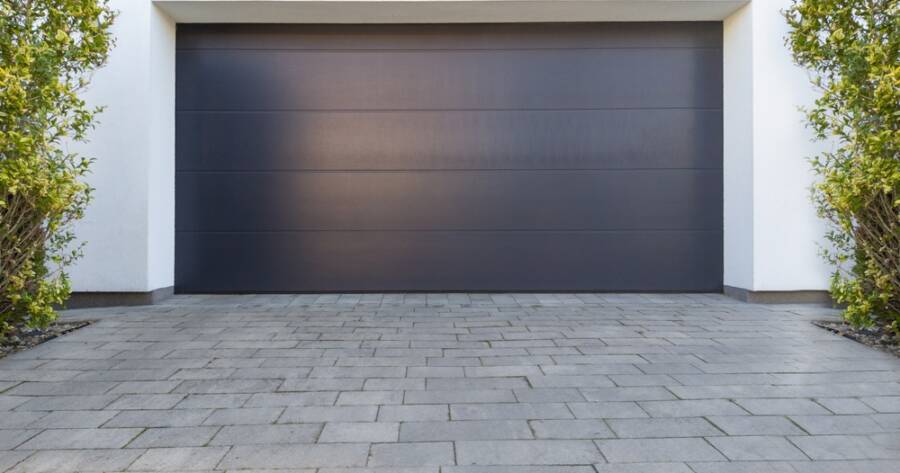
Individual concrete or stone pavers provide another option for homeowners who want more design flexibility. Unlike a single poured slab, damaged pavers can often be replaced individually. Permeable versions can also be installed over a crushed-stone base to allow water to move below the surface rather than immediately running toward the street or storm drain (source). Pavers generally require more installation work than loose gravel, but they offer a much more controlled finished surface.
Choosing the Right Alternative for the Property
No single driveway material is best for every home. Climate matters because snow, freeze-thaw cycles, extreme heat, and heavy rainfall affect materials differently. Slope is equally important. A system that works well on a flat suburban lot may need additional stabilization or drainage measures on a steep property. Vehicle weight, driveway length, appearance, maintenance expectations, and local rules should all factor into the decision (source).
Homeowners interested in permeable surfaces should pay particular attention to what lies below them. Angi notes that permeable driveway systems generally depend on a substantial crushed-stone base to store and manage water, while site conditions determine the exact construction required (source). Proper excavation, grading, drainage, and base preparation can ultimately matter as much as the material visible from the surface.
Finding a Better Fit Than Loose Gravel
Loose gravel remains practical for many properties, particularly when low upfront cost and natural drainage are priorities. Its disadvantages become harder to ignore, however, when stones continually migrate, ruts return, or winter maintenance becomes frustrating. Stabilized gravel grids can preserve the familiar stone appearance, while permeable pavers and grass grids offer greater structure without necessarily sacrificing drainage.
Asphalt, chip seal, concrete, and traditional pavers give homeowners additional choices when a firmer surface is the priority. The right alternative depends less on following a particular trend and more on matching the driveway to the property, climate, vehicles, drainage needs, and maintenance expectations. Comparing those factors before installation can lead to a surface that performs better for years without requiring homeowners to simply accept the recurring drawbacks of loose gravel.