

Subway tile has been a kitchen staple for years, but its once-dominant place on the backsplash is starting to shift. Homeowners are leaning toward choices that feel more distinctive, layered, and personal, giving one of the kitchen’s most visible surfaces a bigger design role. The change is subtle in some spaces and dramatic in others, but the familiar default is no longer the only look getting attention.
Why Subway Tile Is Losing Its Grip on Kitchen Design
For decades, subway tile dominated kitchen remodels across the United States. Its clean lines, affordability, and versatility made it an almost automatic choice. But as design preferences shift toward more personalized and visually dynamic spaces, homeowners and designers alike are actively seeking alternatives that deliver a stronger sense of character and individuality. Moving beyond subway tile allows homeowners to better express personal style while achieving a more distinctive and current kitchen aesthetic (source).
The result is a backsplash landscape that looks dramatically different today. Materials once considered niche or high-end are now appearing in mainstream remodels, and the variety of finishes, textures, and formats available has never been broader. Each emerging option brings something to the table that a standard subway tile simply cannot.
Zellige Tile: Handmade Character in Every Piece
Among the most talked-about materials gaining traction in American kitchens is zellige tile. Rooted in North African craft traditions, zellige is a hand-formed clay tile whose surface is naturally uneven and slightly irregular, meaning no two pieces are identical. This variation is precisely what makes it appealing. “When light hits a zellige backsplash, it looks different at different times of the day,” something machine-made tiles cannot replicate, says Express Kitchens (source).
That quality of shifting visual texture gives zellige a liveliness that flat, uniform tiles cannot achieve. As natural light moves through a kitchen throughout the day, the surface catches and reflects it in constantly changing ways, making the backsplash feel more like a living design element than a static finish. For homeowners who want their kitchen to feel artisanal and warm rather than showroom-perfect, zellige has become a top-tier choice.
Large-Format Slab Backsplashes: The Seamless, Modern Statement
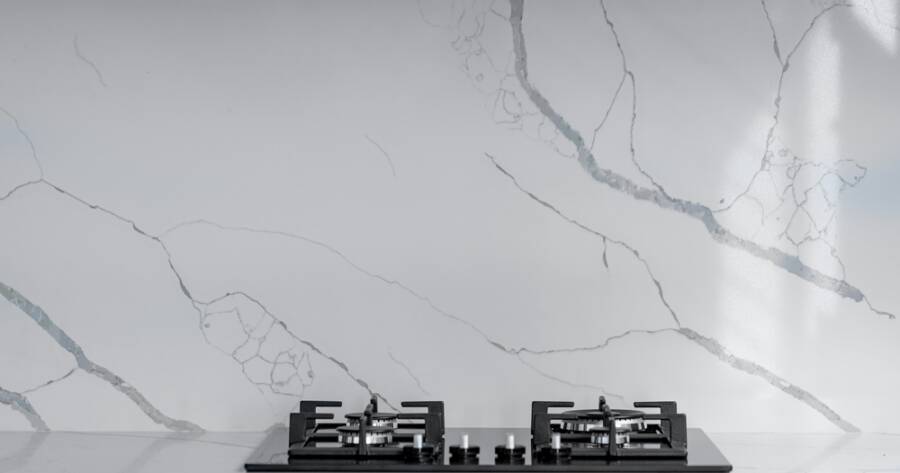
On the opposite end of the texture spectrum, large-format slab backsplashes are delivering sleek, grout-free surfaces that have become synonymous with high-end kitchen design. Rather than individual tiles laid in a grid, a slab backsplash uses a single oversized piece of material, typically quartz, marble, or porcelain, to cover the entire area behind the countertop and range. The effect is a seamless, high-end look that also eliminates grout maintenance (source).
This format pairs naturally with contemporary cabinetry and waterfall-edge countertops, creating kitchens where every surface flows into the next without interruption. Beyond aesthetics, the practical advantage is significant. Without grout lines to harbor moisture, bacteria, and cooking residue, slab backsplashes are easier to clean and maintain over time, which is a genuine selling point for busy households.
Terracotta Tile: Warmth as a Design Strategy
Terracotta tile is one of the most sought-after backsplash styles for kitchen remodels across the United States, particularly as a counterbalance to the cool tones that have dominated kitchen design for years (source). Kitchens built around white quartz countertops and stainless steel appliances can feel clinical or overly sterile, and terracotta introduces an earthy warmth that softens that aesthetic considerably.
The material carries an inherently organic quality, with color variation and a matte finish that reads as grounded and approachable. When paired with wood tones, aged brass hardware, or open shelving, terracotta backsplashes contribute to the broader movement toward kitchens that feel lived-in and inviting rather than purely functional.
Back-Painted Glass and Natural Stone: Two Ends of the Spectrum
For homeowners drawn to ultra-modern kitchens, back-painted glass offers a grout-free, reflective surface that amplifies light and creates a seamless contemporary look (source). Available in virtually any color, this material can be customized to match or contrast cabinetry with precision, and its smooth surface wipes clean with ease.
At the opposite pole, natural stone backsplashes, including marble and slate, deliver organic veining, texture, and unique character that no two installations ever replicate exactly (source). Each slab or tile carries the history of its geological formation, making natural stone one of the few backsplash materials that genuinely cannot be perfectly reproduced. The premium price reflects that exclusivity, but many homeowners consider it a lasting investment.
Artistic and Patterned Tile: The Kitchen Wall as a Canvas
Hand-painted and patterned tiles are increasingly being used as statement backsplashes that treat the kitchen wall as an artistic installation rather than a purely functional surface (source). Geometric motifs, floral patterns, and hand-applied glazes can transform what would otherwise be a background element into the most visually striking feature in the room.
This approach works especially well in kitchens where cabinetry is kept neutral or monochromatic. When the surrounding surfaces are restrained, a richly patterned backsplash becomes the focal point without overwhelming the space. Designers often recommend selecting one or two colors from the tile design and echoing them elsewhere in the room to create coherence without repetition.
Budget-Friendly Options Are Keeping Trends Accessible
Not every homeowner is working with a renovation budget that accommodates natural stone or handcrafted zellige. Peel-and-stick backsplash products have expanded significantly in quality and design variety, offering a far more affordable path to a refreshed kitchen aesthetic. The cost difference is substantial. Peel-and-stick options run significantly lower per square foot compared to traditional tile, which can range considerably higher depending on material and complexity (source).
Modern peel-and-stick products now convincingly mimic the appearance of subway tile, zellige, marble, and even grout-lined formats. While the material difference is apparent up close, from a functional and visual standpoint, these options give renters and budget-conscious homeowners access to contemporary looks without the permanence or expense of a full tile installation. This democratization of design trends has helped accelerate how quickly new styles spread across the broader market.
Why Staying Current on Kitchen Backsplash Trends Matters
The backsplash is one of the most visible surfaces in any kitchen, and the materials chosen for that space have a significant impact on how the entire room reads, including its warmth, its sophistication, and its character. As zellige, large-format slabs, terracotta, natural stone, and artistic tile continue to displace subway tile as the default choice, homeowners stand to gain by understanding what each material brings to the table.
Whether the priority is low maintenance, artisanal texture, or bold visual impact, the current landscape of backsplash options offers something meaningful for every kitchen style and budget. Staying informed about these evolving materials helps homeowners make renovation decisions they will be genuinely satisfied with for years to come.