

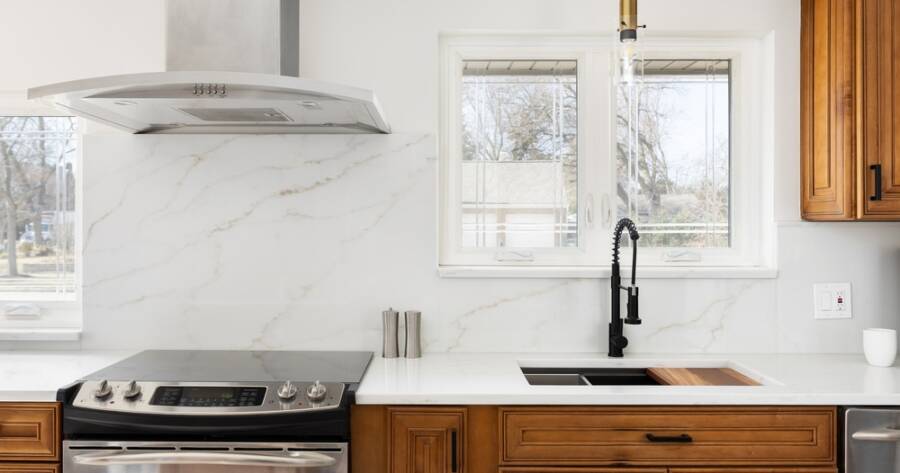
A kitchen backsplash may occupy only a portion of the room, but it can completely change how the space feels. After years of familiar white tile dominating renovation plans, homeowners and designers are taking a more expressive approach. Texture, scale, craftsmanship, and unexpected finishes are creating fresh possibilities for anyone ready to give a kitchen more personality.
Why the Subway Tile Era Is Fading
For decades, the classic 3×6-inch brick-lay subway tile held an almost uncontested position in American kitchen design. Its clean lines and affordability made it a default choice for homeowners and contractors alike. But tastes have shifted, and what once felt timeless now reads as predictable. Designers and homeowners are increasingly seeking materials that carry a sense of individuality, something a factory-produced white rectangle simply cannot deliver.
The shift isn’t just about aesthetics. It reflects a broader desire for kitchens that feel curated rather than installed. The backsplash, often the largest uninterrupted visual surface in a kitchen, has become the space where homeowners express personality and design intent most clearly. As House Beautiful notes, changing up a backsplash “can make your cooking space feel personal, elevated, and brand new” (source).
Zellige and Handmade Tile: The New Artisanal Standard
Among the materials drawing the most attention from designers are zellige and handmade-style ceramic tiles. These options have surged in popularity precisely because of their imperfections — the slight irregularities in surface, glaze depth, and tone that give each tile a distinct character. Mass-produced tiles are engineered to look uniform, but zellige achieves something fundamentally different: a surface that catches light unpredictably and creates a sense of depth across the wall.
Design projects are already demonstrating how versatile zellige can be when applied boldly. In one Seattle kitchen, designer Allison Lind covered both the backsplash and the range hood in octagonal zellige tiles, forming a cohesive focal point that unified two separate elements of the space (source). The high-gloss glaze common to zellige tiles amplifies the handcrafted quality, delivering artisanal character that machine-made tile simply cannot replicate (source).
The Full-Slab Backsplash: A Seamless, High-End Statement
At the premium end of the market, the full-slab backsplash has become the most requested high-end look among design-forward homeowners (source). This approach runs a continuous sheet of quartz, quartzite, or sintered stone from the countertop all the way up to the ceiling, eliminating grout lines entirely and creating an unbroken visual field. The result is a kitchen that feels both architectural and luxurious.
The appeal is practical as well as aesthetic. A surface with no grout lines has fewer places for moisture, grease, and bacteria to accumulate, which is a meaningful advantage in a space defined by heat, steam, and cooking activity. For homeowners who want the drama of natural stone without the maintenance complexity of individual tiles, the slab format offers a compelling solution.
Natural Stone and Raw Materials Gain Ground
Beyond full slabs, raw and natural materials are finding their way into kitchen backsplash design in more textured forms. Limestone, in particular, has emerged as a material that lends warmth and an organic quality that polished surfaces lack. Designer Allison Willson demonstrated this direction by using rubble-finished limestone walls in place of a conventional tile backsplash, producing a kitchen with a storybook, artisan quality that conventional materials could not achieve (source).
Marble continues to hold its place as well, particularly when used in unexpected combinations. Pairing Arabescato Corchia marble alongside pale pink tile, for instance, has been cited as an elegant method of adding visual intrigue and a distinctive signature to a kitchen interior (source). These material pairings reflect a willingness to layer rather than simplify — to let the kitchen carry more visual complexity than a single neutral material would allow.
Large-Format Porcelain: Accessible Minimalism
Not every homeowner is ready to commit to natural stone pricing, and large-format porcelain tile has stepped in as a practical middle ground. With rectified edges and near-invisible grout lines as narrow as 1/16 of an inch, these tiles produce a surface that approaches the seamless look of a full slab at a more accessible price point (source). The result is a clean, low-maintenance backsplash that suits contemporary kitchens without requiring stone-level investment.
Large-format tiles also reduce the visual noise that comes with smaller tile layouts. Fewer grout lines mean fewer interruptions across the wall surface, which creates a calmer, more cohesive backdrop for the rest of the kitchen’s design elements.
Layout and Format Are Evolving, Too
It isn’t only the materials themselves that are changing. The way tiles are arranged is shifting just as dramatically. The standard horizontal brick-lay pattern long associated with subway tile is giving way to vertical stacking, herringbone configurations, and elongated tile formats such as 2×8 or 3×12 dimensions (source). Each of these approaches alters the perceived proportions of a kitchen wall, with vertical stacking drawing the eye upward to make ceilings appear higher and herringbone adding movement and energy to otherwise static surfaces.
These layout decisions are often made in combination with material choices, meaning the same tile in two different configurations can produce entirely different spatial experiences. A 3×12 tile stacked vertically in a matte limestone finish will read very differently from the same format laid in a herringbone pattern with a high-gloss glaze, giving homeowners a significant degree of control over the mood and character of their kitchen without necessarily changing the material itself.
Why You Should Learn More About Kitchen Backsplash Trends Today
The backsplash has evolved from a functional necessity into one of the most expressive design elements in contemporary kitchens. Materials like zellige, natural stone, and large-format porcelain are replacing the predictability of subway tile with surfaces that carry texture, depth, and individuality. Full-slab installations deliver architectural drama while reducing maintenance demands, and evolving tile formats give homeowners new ways to shape how a space feels.
Understanding these trends helps anyone planning a kitchen renovation make choices that will feel both current and enduring rather than selecting a material simply because it was once the default. Staying informed about what leading designers and homeowners are choosing ensures that any investment in a kitchen refresh produces results worth living with for years ahead.