

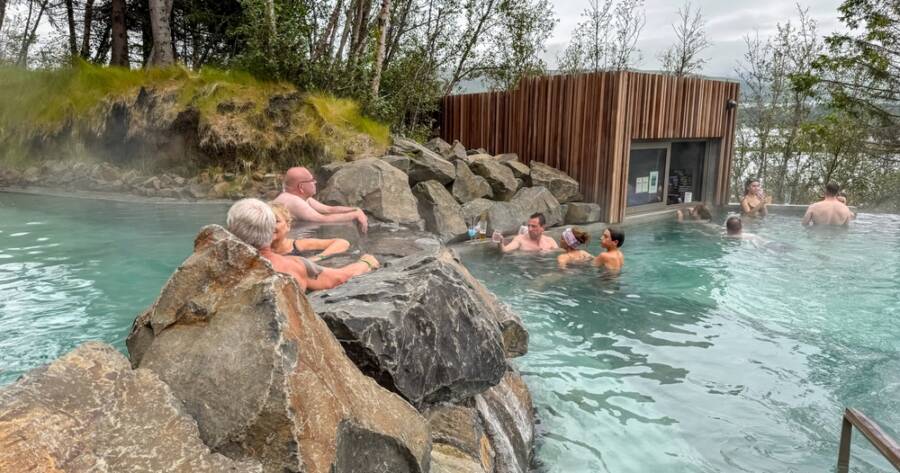
Iceland’s public swimming pools offer visitors a distinctive experience shaped by geothermal activity, community traditions, and local customs. From naturally heated hot pots to mandatory showers without swimwear, most facilities follow practices that may surprise American travelers. Understanding the country’s bathing culture, hygiene rules, and social etiquette can help visitors feel comfortable and prepared before arriving.
A Tradition Rooted in Volcanic Ground
Iceland’s relationship with thermal bathing stretches back to the earliest days of human settlement on the island. Long before modern infrastructure existed, Icelanders recognized the practical and restorative value of the naturally heated waters bubbling up from beneath the earth. That instinct became culture, and culture became tradition (source).
The medieval historian and author Snorri Sturluson was so devoted to the practice that he had a private thermal pool constructed at his estate during the twelfth century, just so he could bathe in hot water at will (source). That kind of personal investment in thermal bathing speaks to how central it has been to Icelandic identity for generations.
Today, Iceland’s bathing culture has received formal international recognition. It earned a place on UNESCO’s 2025 Intangible Cultural Heritage List, a designation that acknowledges not just a leisure activity, but a living cultural practice with deep roots and ongoing social significance (source).
Public Pools as Community Infrastructure
In Iceland, thermal pools are not luxury amenities reserved for resorts or spas. They are public facilities, as fundamental to a town’s identity as a school or a post office. Even small communities with only a few hundred residents often invest in maintaining their own pool complex, typically featuring a heated lap pool alongside one or more smaller soaking pools known as hot pots (source).
The capital region alone hosts seventeen public swimming pools, the majority of which sit outdoors and many of which include additional features like saunas and steam rooms (source). These facilities serve all ages and all walks of life. Historically, when residential apartments commonly lacked private bathing facilities, Icelanders relied on annual pool passes and visited daily as part of their regular routine (source).
That daily ritual shaped something more than clean bodies. It created a social space where neighbors gathered, conversations happened, and community bonds were maintained. While Icelanders certainly appreciate the physical benefits, including improved circulation and muscle relaxation, it is the communal dimension that has kept the practice so deeply embedded in daily life (source).
Iceland’s Public Showers: What Visitors Must Know
For American travelers stepping into an Icelandic public pool for the first time, the shower requirement tends to be the most surprising element. Before entering any pool or hot pot, every visitor is expected to shower thoroughly without a swimsuit (source). This is not a suggestion or a formality. It is a firmly enforced hygiene standard that locals take seriously.
Icelanders hold a relaxed attitude toward nudity in this context, viewing the pre-swim shower as a basic sanitary step rather than something socially charged (source). Attendants at many facilities actively check that visitors have showered properly before they proceed to the water. First-time visitors who understand this expectation ahead of time tend to find the experience far more comfortable.
Temperature is another factor worth noting. The main lap pools are kept at a warm but moderate temperature, typically around 85 degrees Fahrenheit, while hot pots run considerably hotter, hovering around 100 degrees Fahrenheit (source). Most hot pot areas offer several pools at varying heat levels, allowing visitors to move between them at their own pace.
How to Follow Iceland’s Public Pool Shower Rules
Visiting an Icelandic public swimming pool involves a specific routine that begins in the changing room. After paying admission, visitors enter the appropriate changing area, remove their shoes, and store their belongings in a locker. Before putting on swimwear, they must wash thoroughly with soap while completely undressed. Many pools have communal showers, although some facilities offer private stalls. Soap is generally available, so visitors usually only need to bring a swimsuit and towel (source).
After showering, visitors put on their swimsuits and enter the swimming pool or hot pots. When finished bathing, they return to the shower area, remove their swimwear, and rinse off again. Drying thoroughly before returning to the lockers helps keep the changing area clean and safe. Although communal nudity may feel unfamiliar to American travelers, it is treated as a normal part of maintaining hygiene in Iceland’s shared bathing facilities.
The Science Behind the Water
Not all of Iceland’s geothermal waters are the same. Different springs carry distinct mineral profiles that create noticeably different experiences. Some mountain springs draw water rich in iron from deep underground, giving the water a striking color and a natural acidity that can help ease skin redness and irritation (source).
The world-famous Blue Lagoon has an origin story that captures how accidental discovery shaped modern bathing culture. It formed when excess water released from the nearby Svartsengi Power Plant pooled in the surrounding lava field. A worker with severe psoriasis noticed his skin responding positively to the water, which eventually prompted scientific research and the establishment of a dedicated psoriasis clinic there in 1994 (source).
The silica-rich water at the Blue Lagoon is chemically quite different from mineral springs found elsewhere in the country. This variety across Iceland’s geothermal landscape means that each location offers visitors something distinct, whether the draw is geology, skin care, or simply soaking in naturally heated water beneath an open sky.
Respecting the Hot Pot Culture
Beyond the shower requirement, there are broader social expectations that shape the hot pot experience. Conversations in hot pots tend to be relaxed and unhurried. Visitors who arrive with a quiet, respectful approach tend to blend in more naturally with the local rhythm. Loud behavior or rushing through the space runs counter to the meditative, communal spirit that Icelanders associate with these pools.
The hot pots in particular serve as informal social venues. Locals discuss politics, share news, and catch up with neighbors while soaking. For visiting Americans, treating the hot pot as a social equalizer rather than a tourist attraction tends to result in a richer, more genuine experience of Icelandic daily life.
Why You Should Learn More About Iceland’s Bathing Culture
Iceland’s public pool tradition offers American visitors something rare: direct access to a living cultural practice that has shaped daily life for centuries. From the volcanic science beneath each pool to the social customs observed inside the changing rooms, every element reflects a deeply rooted relationship between people, community, and natural environment.
Understanding the shower etiquette, temperature differences, and communal values before arriving transforms the experience from a novelty into something genuinely meaningful. Iceland’s geothermal bathing culture, now recognized by UNESCO, stands as one of the most authentic and accessible windows into the Icelandic way of life that any traveler can experience firsthand.