

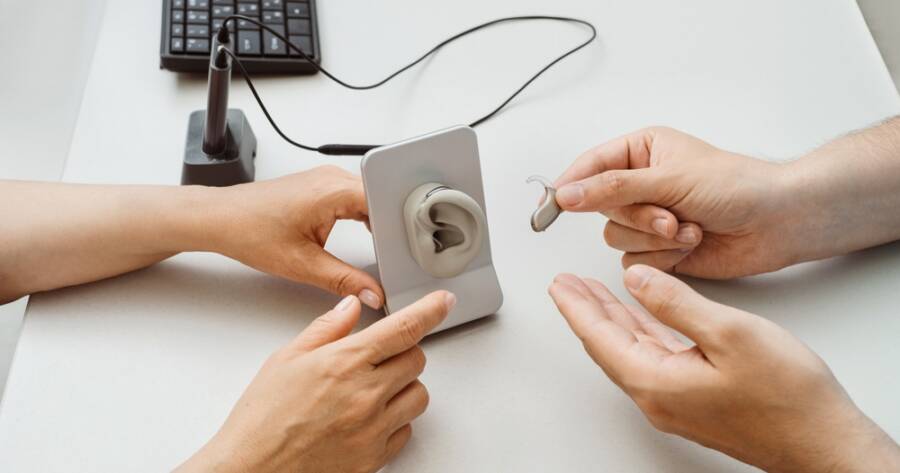
Traditional hearing aids remain the main solution for many people with hearing loss, but they are no longer the only option being developed or used. New technologies are improving how sound is processed, expanding implant-based treatments, and navigating ways to correct hearing loss at a biological level.
Why Traditional Hearing Aids Have Limits
Conventional hearing aids work by amplifying sound so that speech and environmental noise become easier to hear. Their limitation is that they cannot always separate a desired voice from competing background noise, especially in busy places such as restaurants, meetings, or family gatherings (source).
Modern hearing technology is therefore moving in two directions. One is improving amplification through better signal processing and personalization. The other is developing alternatives that bypass or potentially repair damaged parts of the auditory system.
Smarter Hearing Aids Through Open-Source Research
One important area of progress is not a new consumer device, but a research platform called openMHA. It allows researchers to test and modify hearing-aid processing functions such as background-noise reduction, amplification, compression, and feedback control without depending on proprietary commercial systems (source).
Another platform, Tympan, provides wearable hardware that lets researchers run custom audio-processing experiments in real time. Together, these tools are helping scientists develop more personalized approaches to hearing assistance and evaluate new algorithms before they are incorporated into commercial devices (source).
These platforms are not replacements that consumers can simply buy instead of a hearing aid. Their importance lies in making future hearing devices more adaptive and more capable of handling complex listening environments.
Cochlear and Brainstem Implants Offer Alternatives for Some Patients
For people with severe or profound hearing loss who receive limited benefit from conventional hearing aids, cochlear implants can provide an alternative. Rather than simply making sound louder, these devices convert sound into electrical signals that stimulate the auditory nerve.
Researchers are also studying auditory brainstem implants for people who cannot benefit from cochlear implants because the auditory nerve is damaged or absent. NIDCD-supported work involving the Utah Slant Electrode Array is aimed at improving stimulation of the auditory brainstem for selected patients (source).
This technology is still experimental, but it shows how hearing care is expanding beyond devices worn behind the ear. In certain cases, future treatment may increasingly depend on where damage occurs within the auditory pathway.
Gene Therapy Could Change How Some Hearing Loss Is Treated
A more radical approach is to treat the biological cause of hearing loss itself. Researchers have identified more than 150 genes linked to inherited forms of hearing loss, which has opened the door to therapies designed for specific genetic conditions (source).
Clinical trials are now testing gene therapy for congenital hearing loss associated with variants in the OTOF gene. These treatments are investigational and are not yet approved as routine therapy, but they represent an important shift from compensating for hearing loss to attempting to correct its underlying cause (source).
If successful and eventually approved, gene therapy could reduce the need for hearing aids or implants in certain narrowly defined patient groups. However, it is unlikely to replace hearing aids broadly because hearing loss can result from many different genetic, age-related, environmental, and medical causes.
Gene Editing Is an Even Earlier-Stage Possibility
Researchers are also exploring gene-editing technologies such as CRISPR as a possible way to alter genes associated with hearing loss. NIDCD describes this as a future possibility rather than an established treatment (source).
The potential is significant because gene editing could eventually address some forms of inherited hearing loss at the molecular level. At present, however, this work remains far earlier in development than conventional hearing aids, cochlear implants, or even current gene-therapy trials.
For patients and families, the distinction matters: gene editing is a promising research direction, not a treatment that can currently be chosen instead of a hearing aid.
Personalization Is Becoming as Important as the Device Itself
One of the clearest trends across hearing technology is greater personalization. Hearing loss varies not only in severity but also in cause, frequency range, nerve function, and the listening situations that matter most to each person.
Open-source research platforms make it easier to test individualized processing strategies, while implants can be selected according to the location and severity of auditory damage. Genetic testing may eventually help identify people who could benefit from targeted biological therapies.
This means the future of hearing care is unlikely to revolve around a single replacement for the traditional hearing aid. Instead, patients may have access to a wider set of options chosen according to the specific biology and functional needs behind their hearing loss.
What Is Actually Replacing Traditional Hearing Aids Today?
For most people with mild to moderate hearing loss, modern hearing aids remain the standard treatment. They are becoming smaller, more connected, and better at adapting to different listening environments rather than disappearing altogether.
The strongest current alternatives are cochlear implants for appropriate patients with severe hearing loss and, in much narrower circumstances, auditory brainstem implants. Gene therapy and gene editing may eventually reduce reliance on hearing devices for certain genetic conditions, but they remain experimental.
So the real change is not that traditional hearing aids are suddenly being replaced across the board. It is that hearing care is becoming more diverse, with multiple technologies available or under development for different causes and levels of hearing loss.
Why Hearing Technology Is Worth Following
Hearing technology is moving from simple amplification toward more individualized, biologically informed care. Smarter signal processing is improving conventional devices, implants are expanding options for people who cannot benefit from hearing aids, and gene-based therapies are beginning to test whether some inherited forms of hearing loss can be treated at their source.
For patients and families, the most useful approach is to separate what is available now from what remains experimental. Traditional hearing aids are still highly relevant, but they are increasingly becoming one option within a broader and more sophisticated hearing-care landscape.